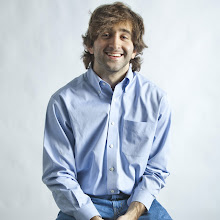
"People are happiest doing what they're good at."
"You should strive to achieve happiness every day, not just at the end of a journey."
- Former President Bill Clinton, at the 2011 NYU Commencement at Yankee Stadium.
Wednesday, May 18, 2011

Tuesday, May 17, 2011
Frank Wess
This past Saturday, I had the pleasure of seeing a live interview with jazz legend Frank Wess. His statements and answers were very powerful, and I wanted to share a few of my favorites with you.
On learning the craft: "Good musical sound, good time, and to be able to play a melody. If you can do that, you can get away without having all the theory in the world."
"When you play all those fast notes...Who's going to be able to hum that when they get in bed?" - Wess' quick response to being asked what's missing in jazz today.
"It ain't got nothing to do with the chords." - Wess, on the importance of melody in his solos. He was asked specifically if, when learning a song, he practices playing through the chord changes.
On learning the craft: "Good musical sound, good time, and to be able to play a melody. If you can do that, you can get away without having all the theory in the world."
"When you play all those fast notes...Who's going to be able to hum that when they get in bed?" - Wess' quick response to being asked what's missing in jazz today.
"It ain't got nothing to do with the chords." - Wess, on the importance of melody in his solos. He was asked specifically if, when learning a song, he practices playing through the chord changes.
Tuesday, May 10, 2011
Ahmad Jamal Interview
This past Saturday, I had the honor and pleasure of interviewing the great Ahmad Jamal. Not only has he been one of the most influential jazz musicians of all time, but his music has been instrumental (no pun intended) in my development as a musician; in fact, it was his recording of "Like Someone In Love" that got me hooked on jazz. For years, I've had many questions that I've wished I could ask Mr. Jamal, and this past Saturday I was given that opportunity. He was extremely kind, honest, thoughtful, and giving in his answers. It was an absolute thrill to speak with one of my heroes, the great Ahmad Jamal, and I hope you enjoy reading the following bits from our conversation.
Joe Alterman: One of the things that I’ve always loved about your playing is your repertoire. I’m curious how you were originally introduced to the great standards.
Ahmad Jamal: My aunt, who was an educator in North Carolina, sent me many, many compositions via sheet music, and that’s how I gained the vast repertoire that you hear me indulge in. I was sent those things by her gracious efforts from 10 years old and on. So my Aunt Louise was the one responsible for me acquiring that vast repertoire of standards…It’s a combination of what she did and also working around one of the great cities for musicians, or people who were developing a career in music: Pittsburgh, Pennsylvania. So working with groups in Pittsburgh, and what she sent me, and the environment under which I grew up in. As you know I…well you don’t know (laughter), but I sold papers to Billy Strayhorn’s family when I was seven years old. So we [Pittsburgh] have Billy Strayhorn and Erroll Garner and Earl Hines and Roy Eldridge, Ray Brown, Art Blakey, and a pianist that you’ve probably never heard of, Dodo Momarosa. He was a great pianist…And Earl Wild, the great exponent of Liszt; a great interpreter of Franz Liszt…And Gene Kelly the tap dancer. The list goes on and on and on…George Benson, who was a much later personality that developed in Pittsburgh. But he’s a Pittsburgh personality, as well as Stanley Turrentine. It goes on and on and on.
JA: Mary Lou Williams too. Right?
AJ: Mary Lou came there when she was very, very young – a lot of people think she’s from Pittsburgh…but she came there when she was very, very young. I think she’s from Georgia, but she came to Pittsburgh when she was three or four years old. She went to the same high school I went to. And you can’t forget Billy Eckstine and Kenny Clarke…All those masters come from Pittsburgh.
JA: A couple months ago, Jimmy Heath came to NYU to give a class, and our teacher asked, “What was it like growing up in Philadelphia?” And he said, “I don’t want to talk about that. The great music town was Pittsburgh.”
AJ: (Lots of laughter) They had some great musicians too. That’s all the same; I kind of group them all as “Pennsylvanians.” Philadelphia had some wonderful artists, and Harrisburg produced one of the great bassists of all time, who I was just thinking about recently, Dr. Art Davis. Jimmy Smith is from Pennsylvania as well. So we have a grouping there. Philadelphia was a great area for music, but that’s all part of Pennsylvania. (laughter)
JA: There’s a bunch of tunes you played that are really rare, such as “Music, Music, Music”, tunes that you may have the only jazz version of. Were you purposely trying to pick out songs that weren’t played as frequently? Or did you just like those songs?
AJ: No, I just played songs that I liked. I just picked out songs that I favored; it wasn’t an attempt to do anything but use the repertoire and use the things that I had learned and heard in my growing-up years.
JA: Do you remember when you first heard “Poinciana”?
AJ: “Poinciana” was a part of the repertoire that Dr. Joseph Kennedy, Jr. had in our book. Joe Kennedy, the great violinist and educator - who is also from Pennsylvania. McDonald, which is also part of Pittsburgh…suburbia. But he had that in the repertoire when I formed “The Three Strings.” It was a spin-off from “The Four Strings;” I was the pianist in that, which was his group. I was introduced to “Poinciana” through his repertoire and what he wrote and what he selected as compositions that “The Four Strings” should perform. It was Joe Kennedy, myself, and Ray Crawford, the guitarist. Joe Kennedy was a master violinist.
JA: Do you learn the lyrics to the songs you play? Are lyrics important to you?
AJ: You have to…Well you don’t have to, but in order to re-interpret these things correctly or in a more informed-of manner, you should know the lyrics or know something about the lyrics. It gives you an idea about what the composer had in mind. Most of the songs that I perform I know the lyrics.
In fact, recently I’ve started writing lyrics to a lot of my things. I’m beginning to write lyrics to a composition that I wrote which is also going to Moscow, “Flight to Russia.” I think I’m going to send that to Igor Butman. I think Igor is one of the really popular musicians in Russia; I think he went to Berkeley too. James [Cammack] is well aware of Igor. I’m in the process of doing that as well.
So, lyrics are very essential. It’s like the famous story about Ben Webster, the great saxophonist. He’s playing a beautiful ballad…you’ve heard this story many times but I’m going to repeat it: Ben Webster was one of the great ballad players of all time, and he was playing this wonderful ballad and he suddenly stopped. And they said, “Ben, why in the world did you stop?” He said, “I forgot the lyrics.” You’ve heard that story before?
JA: Yes. I was reading an interview with Bill Evans and the interviewer asked him the same question and Evans said that he’s never learned any lyrics, he doesn’t care for them, and that the singer might as well be a horn player.
AJ: (Laughter). Well, different strokes for different folks. But, to me, lyrics are very essential. You know, you don’t have to, but I think you’re a more informed interpreter if you know the lyrics.
JA: Did you work consciously on your touch? You’ve got the “magic touch.”
AJ: Well, you know, that’s the interesting thing about Horowitz: he’s playing the same repertoire, but it’s his touch that makes the difference. If you listen to Horowitz or some of the great people who work in the European body of work, it’s the same repertoire. But, everything lies in the touch. Horowitz had a great touch.
JA: One of the other people I think of, in jazz, with a great touch is Hank Jones.
AJ: Hank Jones had a wonderful touch. So did Art Tatum. In fact, that should be a prerequisite for every music student: Tiny Grimes, Slam Stewart, and Art Tatum playing “Flying Home.” Whether you’re working in a European body of work or in American Classical repertoire, the prerequisite should be Art Tatum’s “Flying Home.”
That’s a unique thing about people in American Classical Music, which is a phrase I coined some time ago: you have to know the best of both worlds. I was playing Franz Liszt in competition when I was ten years old, but I was also playing Duke Ellington. So that’s a marvelous thing about the wonderful players that make up our genre. We have to be multi-dimensional. Dave Brubeck has to know Mozart. He has to know Duke Ellington, and it’s the same way with George Shearing; he can play the concertos but he can also write “Lullaby of Birdland.” So that’s the wonderful thing about people that are working in our field. They’re multi-dimensional; they’re not one-dimensional. That’s why I call them “American Classicists.” I think that “jazz” does not define properly what we do. I’m not paranoid about the term “jazz” but I don’t call myself a “jazz musician.” I call myself and my colleagues, the John Coltranes, and the Duke Ellingtons, “American Classicists.”
There are only two art forms that developed in the United States and that’s American Indian art and this thing we call jazz. I call it American Classical Music and that’s what it is. The little thoughts that we have here have been put here by way of these two developments: American Indian Art and American Classical Music, both of which are never promoted. You don’t see Duke Ellington every day on the television. You should, but you don’t. You don’t see Dave Brubeck every day on the television. You don’t see me and you don’t see George Shearing, but you should. You don’t see Louis Armstrong. But in Europe, you do. Not here, and that’s unfortunate.
JA: I’m wondering if you were purposely trying to innovate this music, which is what I often hear from different educators that the greats such as yourself did, or if you played what you loved and it just happened to be different.
AJ: Well, the fact is that all Pittsburghers are uniquely different. No one plays piano like Erroll Garner. No one plays bass like Ray Brown. No one plays piano like Earl Hines. No one plays drums like Art Blakey. No one plays saxophone like Stanley Turrentine. We all have ushered in a different era that’s just one of the unique phenomena of Pittsburgh. No one danced like Gene Kelly. No one interpreted Liszt quite like Earl Wild. Lorin Maazel, the conductor, is from Pittsburgh too. Andy Warhol is from Pittsburgh. It goes on and on. It’s very difficult for me to exhaust the list but all of us are different and unique so it’s just a phenomenon that all of us have a different approach. This is a thing that happened to me as a result of growing up there; I followed that same pattern.
JA: Were you close with Erroll Garner?
AJ: My mother and his mother were friends, but I didn’t meet Erroll until after because he was working in places I couldn’t go in was a kid. Erroll had the best jobs in Pittsburgh and I was too young to go where he was working. So I didn’t know Erroll until later. He came back to Westinghouse High School and played for us. I was amazed because it seemed as though he was playing on all the black keys and in all the multi-flat and multi-sharp keys. He was certainly a person who heard everything in all the keys…B Natural, G Flat, F Sharp; it didn’t make any difference.
He was quite a stride player, too. A lot of people don’t know that. So I didn’t know Erroll until later on; I met him after I left home.
JA: I know you’re obviously influenced by Garner and Nat Cole, but one of the things that people don’t talk about as much as they talk about your linear and melodic lines is your mastery of the block chord technique. Who influenced you in terms of block chords? Erroll Garner? George Shearing? Milt Buckner?
AJ: If you really want to do a study on the mastery of block chords you have to listen to Phineas Newborn. Even today, he’s certainly underrated…That’s another area that’s produced some fantastic musicians: Memphis. My former bassist, the late Jamil Nasser, is one of them. But Phineas is from Memphis and so is Harold Mabern, who’s doing a professorship at one of your schools now – William Patterson College I think.
The block chords is, to me, demonstrated more by people like Phineas than myself. But I didn’t learn anything from George Shearing; we’re peers. I mean I admired George, but my influences were Erroll and Nat and Art Tatum.
JA: In the ‘50’s and ‘60’s people like you, Erroll Garner, Ray Brown, Oscar Peterson, and Dave Brubeck were the most popular guys around; but a lot of times in the textbooks and classes in schools they don’t talk about those people as much; instead they focus on people like George Russell, Lennie Tristano, and Cecil Taylor. Does this surprise you at all?
AJ: I pay little attention to that. I’m so busy doing my own thing that I don’t reflect on what the people are crediting and giving other people in my field. It’s just a waste of time for me. You know? (Laughter)
JA: Are you a book lover? A movie lover?
AJ: I don’t do movies at all. I like non-fiction and if I read, it has to be non-fiction. I don’t like fiction; I like the real thing. And I have books that I read but most of them are philosophical. I’m going back to the discipline of reading; I used to gobble up books when I was a youngster. But I’m going back to it now. In fact, I was surprised at myself: I was waiting for my car to be serviced today and I was reading the editorials in the Wall Street Journal, and I was reading also about the focus on the new approach to music videos. It was very interesting. A lot of it has stuff to do with things that are not musical, as far as I’m concerned. A lot of stuff on MTV has nothing to do with music, but that’s what we’ve created here. We have a focus on non-musical things and a lack of focus on musical things. Music is supposed to sooth the savaged beast and in many instances we’re raising the savaged beast.
But my point is that I’m getting back to the discipline of reading, which I lost some years ago.
Most of the things I read are non-fiction and I don’t care for movies too much. The last movies I went to see was “The Bridges of Madison County” because my daughter said Clint Eastwood had two of my recordings in part of the soundtrack. I wanted to see that. That’s the first thing you hear, soundtrack-wise, are my recordings of “Music, Music, Music” and “Poinciana”.
JA: Does it bother you that there is so much music in the background these days? Like at the mall while you’re shopping, for example.
AJ Not as long as it’s good music. I can’t stand the commercials. Without the mute button, I could never tolerate television because some of the commercials are just horrible. I don’t know what these manufacturers are thinking of because you can sell a product, to me, much more effectively with music that soothes and is not irritable and not nerve-wracking, as opposed to what they have now. I don’t know why they chose to do the negative instead of the positive on these commercials.
JA: I’ve been fortunate enough to be in contact with Houston Person, and one of the things he talks about is that it’s an enormous responsibility to have people come out at night and spend their hard-earned money on him. He wants to play good music of course, but he wants to relax the people in the audience; he doesn’t want to make them nervous with the music, and he feels a great responsibility to do this, especially after the people worked so hard for their money that they’re spending on him. Do you agree?
AJ: I have two words: He’s right.
JA: I find it interesting that you’re one of the few great pianists that didn’t come up as, or wasn’t documented as, a sideman, backing horn players for example. It seems that you’ve always been known as a leader. Did you ever do more sideman work and how did you make it as a leader?
AJ: Your question is a very interesting one and it has to do with my longevity in the field. I started playing at three years old, which is very, very young. That’s what I say when people ask, “How did you choose music?” I say, when you are that young, you don’t make conscious decisions, Joe. Music chose me; I didn’t choose it, and I was working as a sidemen at ten years old. I worked with groups around Pittsburgh for many years. I worked on the road with a song and dance team. So I had a history of being a sideman. I worked with George Hudson’s orchestra; he made me leave my happy home in 1948. I left at 17 years old and worked all over the country with him. Out of that band came Clark Terry and the great writer Ernie Wilkins. He was a great orchestrator, and I think he passed [away] in Europe, in Copenhagen. I was a sideman for many, many, many years…When I was young; that was part of my growing-up years…I was an old man by the time I was 18 (laughter). I went from young to old very quick and what made me old was when I started my group in 1951. That was the end of any sideman issues; I had to keep my men working, and I’ve had that responsibility now for over five decades, Joe: being a leader. But I was a sideman for many, many years in and around Pittsburgh and all over the United States with a group called the Cardwells. When I left that group, Ray Bryant, the great pianist, became their person in the pianists’ chair. And I worked with George Hudson all over; that was my first time at the Apollo Theater actually. We were touring with stars like Dinah Washington at that time so I was a sideman for many years. I became a leader at a very young age; I was 21 years old, so that’s quite a span of time.
JA: I know Miles Davis loved you. Did you two ever talk about playing together?
AJ:No, because he was leading and I was leading. That never happened; there was some attempt to get Miles and Cannonball and myself on record together, but that never reached fruition.
JA: I love the video of you and your trio playing “Darn That Dream”.
AJ:Oh yes. With Israel Crosby and Vernell Fourier as my guys, the masters that helped make my career what it is.
JA: In that video, I see Hank Jones standing over your shoulder, and Ben Webster.
AJ: That’s correct. Ben Webster, who I spoke of, is there. Jo Jones – Papa Jo that is – and some of the other greats were there: George Duvivier and Buck Clayton…That’s a classic. That video’s a classic.
JA: That must have been nerve-wracking. Did you used to get nervous?
AJ: I don’t remember what I got (Laughter). I know it was a very interesting experience, and it’s still being shown all over the world, especially now with the Internet.
JA: Do you teach?
AJ: I taught for a brief period of time in Chicago, my second home. But, you know, teaching is something you must dedicate your life to in order to give that student his or her due. So, I haven’t taught in a long, long time. I spent a period of time doing that in Chicago. I had this hit record, or what they call a hit record for instrumentalists. We don’t have hit records, but I had one and Dave Brubeck had one with “Take Five” and Herbie Hancock had a few and Chuck Mangione and Miles, but very few instrumentalists had hits. Singers get the hits but I did have one, and that took me away from teaching and I never went back to it (laughter). I was performing, and that’s what I’ve been devoting my life to. And now I’ve been devoting my life to resetting and reshaping my career, doing what I love so much, and that’s composing. I’m trying to get away from the sense of urgency that the cell-phone and the computer and all the activities have thrust upon us, and I’ve been trying to do the things I really love to do, which is playing in my favorite venue: my home.
Joe Alterman: One of the things that I’ve always loved about your playing is your repertoire. I’m curious how you were originally introduced to the great standards.
Ahmad Jamal: My aunt, who was an educator in North Carolina, sent me many, many compositions via sheet music, and that’s how I gained the vast repertoire that you hear me indulge in. I was sent those things by her gracious efforts from 10 years old and on. So my Aunt Louise was the one responsible for me acquiring that vast repertoire of standards…It’s a combination of what she did and also working around one of the great cities for musicians, or people who were developing a career in music: Pittsburgh, Pennsylvania. So working with groups in Pittsburgh, and what she sent me, and the environment under which I grew up in. As you know I…well you don’t know (laughter), but I sold papers to Billy Strayhorn’s family when I was seven years old. So we [Pittsburgh] have Billy Strayhorn and Erroll Garner and Earl Hines and Roy Eldridge, Ray Brown, Art Blakey, and a pianist that you’ve probably never heard of, Dodo Momarosa. He was a great pianist…And Earl Wild, the great exponent of Liszt; a great interpreter of Franz Liszt…And Gene Kelly the tap dancer. The list goes on and on and on…George Benson, who was a much later personality that developed in Pittsburgh. But he’s a Pittsburgh personality, as well as Stanley Turrentine. It goes on and on and on.
JA: Mary Lou Williams too. Right?
AJ: Mary Lou came there when she was very, very young – a lot of people think she’s from Pittsburgh…but she came there when she was very, very young. I think she’s from Georgia, but she came to Pittsburgh when she was three or four years old. She went to the same high school I went to. And you can’t forget Billy Eckstine and Kenny Clarke…All those masters come from Pittsburgh.
JA: A couple months ago, Jimmy Heath came to NYU to give a class, and our teacher asked, “What was it like growing up in Philadelphia?” And he said, “I don’t want to talk about that. The great music town was Pittsburgh.”
AJ: (Lots of laughter) They had some great musicians too. That’s all the same; I kind of group them all as “Pennsylvanians.” Philadelphia had some wonderful artists, and Harrisburg produced one of the great bassists of all time, who I was just thinking about recently, Dr. Art Davis. Jimmy Smith is from Pennsylvania as well. So we have a grouping there. Philadelphia was a great area for music, but that’s all part of Pennsylvania. (laughter)
JA: There’s a bunch of tunes you played that are really rare, such as “Music, Music, Music”, tunes that you may have the only jazz version of. Were you purposely trying to pick out songs that weren’t played as frequently? Or did you just like those songs?
AJ: No, I just played songs that I liked. I just picked out songs that I favored; it wasn’t an attempt to do anything but use the repertoire and use the things that I had learned and heard in my growing-up years.
JA: Do you remember when you first heard “Poinciana”?
AJ: “Poinciana” was a part of the repertoire that Dr. Joseph Kennedy, Jr. had in our book. Joe Kennedy, the great violinist and educator - who is also from Pennsylvania. McDonald, which is also part of Pittsburgh…suburbia. But he had that in the repertoire when I formed “The Three Strings.” It was a spin-off from “The Four Strings;” I was the pianist in that, which was his group. I was introduced to “Poinciana” through his repertoire and what he wrote and what he selected as compositions that “The Four Strings” should perform. It was Joe Kennedy, myself, and Ray Crawford, the guitarist. Joe Kennedy was a master violinist.
JA: Do you learn the lyrics to the songs you play? Are lyrics important to you?
AJ: You have to…Well you don’t have to, but in order to re-interpret these things correctly or in a more informed-of manner, you should know the lyrics or know something about the lyrics. It gives you an idea about what the composer had in mind. Most of the songs that I perform I know the lyrics.
In fact, recently I’ve started writing lyrics to a lot of my things. I’m beginning to write lyrics to a composition that I wrote which is also going to Moscow, “Flight to Russia.” I think I’m going to send that to Igor Butman. I think Igor is one of the really popular musicians in Russia; I think he went to Berkeley too. James [Cammack] is well aware of Igor. I’m in the process of doing that as well.
So, lyrics are very essential. It’s like the famous story about Ben Webster, the great saxophonist. He’s playing a beautiful ballad…you’ve heard this story many times but I’m going to repeat it: Ben Webster was one of the great ballad players of all time, and he was playing this wonderful ballad and he suddenly stopped. And they said, “Ben, why in the world did you stop?” He said, “I forgot the lyrics.” You’ve heard that story before?
JA: Yes. I was reading an interview with Bill Evans and the interviewer asked him the same question and Evans said that he’s never learned any lyrics, he doesn’t care for them, and that the singer might as well be a horn player.
AJ: (Laughter). Well, different strokes for different folks. But, to me, lyrics are very essential. You know, you don’t have to, but I think you’re a more informed interpreter if you know the lyrics.
JA: Did you work consciously on your touch? You’ve got the “magic touch.”
AJ: Well, you know, that’s the interesting thing about Horowitz: he’s playing the same repertoire, but it’s his touch that makes the difference. If you listen to Horowitz or some of the great people who work in the European body of work, it’s the same repertoire. But, everything lies in the touch. Horowitz had a great touch.
JA: One of the other people I think of, in jazz, with a great touch is Hank Jones.
AJ: Hank Jones had a wonderful touch. So did Art Tatum. In fact, that should be a prerequisite for every music student: Tiny Grimes, Slam Stewart, and Art Tatum playing “Flying Home.” Whether you’re working in a European body of work or in American Classical repertoire, the prerequisite should be Art Tatum’s “Flying Home.”
That’s a unique thing about people in American Classical Music, which is a phrase I coined some time ago: you have to know the best of both worlds. I was playing Franz Liszt in competition when I was ten years old, but I was also playing Duke Ellington. So that’s a marvelous thing about the wonderful players that make up our genre. We have to be multi-dimensional. Dave Brubeck has to know Mozart. He has to know Duke Ellington, and it’s the same way with George Shearing; he can play the concertos but he can also write “Lullaby of Birdland.” So that’s the wonderful thing about people that are working in our field. They’re multi-dimensional; they’re not one-dimensional. That’s why I call them “American Classicists.” I think that “jazz” does not define properly what we do. I’m not paranoid about the term “jazz” but I don’t call myself a “jazz musician.” I call myself and my colleagues, the John Coltranes, and the Duke Ellingtons, “American Classicists.”
There are only two art forms that developed in the United States and that’s American Indian art and this thing we call jazz. I call it American Classical Music and that’s what it is. The little thoughts that we have here have been put here by way of these two developments: American Indian Art and American Classical Music, both of which are never promoted. You don’t see Duke Ellington every day on the television. You should, but you don’t. You don’t see Dave Brubeck every day on the television. You don’t see me and you don’t see George Shearing, but you should. You don’t see Louis Armstrong. But in Europe, you do. Not here, and that’s unfortunate.
JA: I’m wondering if you were purposely trying to innovate this music, which is what I often hear from different educators that the greats such as yourself did, or if you played what you loved and it just happened to be different.
AJ: Well, the fact is that all Pittsburghers are uniquely different. No one plays piano like Erroll Garner. No one plays bass like Ray Brown. No one plays piano like Earl Hines. No one plays drums like Art Blakey. No one plays saxophone like Stanley Turrentine. We all have ushered in a different era that’s just one of the unique phenomena of Pittsburgh. No one danced like Gene Kelly. No one interpreted Liszt quite like Earl Wild. Lorin Maazel, the conductor, is from Pittsburgh too. Andy Warhol is from Pittsburgh. It goes on and on. It’s very difficult for me to exhaust the list but all of us are different and unique so it’s just a phenomenon that all of us have a different approach. This is a thing that happened to me as a result of growing up there; I followed that same pattern.
JA: Were you close with Erroll Garner?
AJ: My mother and his mother were friends, but I didn’t meet Erroll until after because he was working in places I couldn’t go in was a kid. Erroll had the best jobs in Pittsburgh and I was too young to go where he was working. So I didn’t know Erroll until later. He came back to Westinghouse High School and played for us. I was amazed because it seemed as though he was playing on all the black keys and in all the multi-flat and multi-sharp keys. He was certainly a person who heard everything in all the keys…B Natural, G Flat, F Sharp; it didn’t make any difference.
He was quite a stride player, too. A lot of people don’t know that. So I didn’t know Erroll until later on; I met him after I left home.
JA: I know you’re obviously influenced by Garner and Nat Cole, but one of the things that people don’t talk about as much as they talk about your linear and melodic lines is your mastery of the block chord technique. Who influenced you in terms of block chords? Erroll Garner? George Shearing? Milt Buckner?
AJ: If you really want to do a study on the mastery of block chords you have to listen to Phineas Newborn. Even today, he’s certainly underrated…That’s another area that’s produced some fantastic musicians: Memphis. My former bassist, the late Jamil Nasser, is one of them. But Phineas is from Memphis and so is Harold Mabern, who’s doing a professorship at one of your schools now – William Patterson College I think.
The block chords is, to me, demonstrated more by people like Phineas than myself. But I didn’t learn anything from George Shearing; we’re peers. I mean I admired George, but my influences were Erroll and Nat and Art Tatum.
JA: In the ‘50’s and ‘60’s people like you, Erroll Garner, Ray Brown, Oscar Peterson, and Dave Brubeck were the most popular guys around; but a lot of times in the textbooks and classes in schools they don’t talk about those people as much; instead they focus on people like George Russell, Lennie Tristano, and Cecil Taylor. Does this surprise you at all?
AJ: I pay little attention to that. I’m so busy doing my own thing that I don’t reflect on what the people are crediting and giving other people in my field. It’s just a waste of time for me. You know? (Laughter)
JA: Are you a book lover? A movie lover?
AJ: I don’t do movies at all. I like non-fiction and if I read, it has to be non-fiction. I don’t like fiction; I like the real thing. And I have books that I read but most of them are philosophical. I’m going back to the discipline of reading; I used to gobble up books when I was a youngster. But I’m going back to it now. In fact, I was surprised at myself: I was waiting for my car to be serviced today and I was reading the editorials in the Wall Street Journal, and I was reading also about the focus on the new approach to music videos. It was very interesting. A lot of it has stuff to do with things that are not musical, as far as I’m concerned. A lot of stuff on MTV has nothing to do with music, but that’s what we’ve created here. We have a focus on non-musical things and a lack of focus on musical things. Music is supposed to sooth the savaged beast and in many instances we’re raising the savaged beast.
But my point is that I’m getting back to the discipline of reading, which I lost some years ago.
Most of the things I read are non-fiction and I don’t care for movies too much. The last movies I went to see was “The Bridges of Madison County” because my daughter said Clint Eastwood had two of my recordings in part of the soundtrack. I wanted to see that. That’s the first thing you hear, soundtrack-wise, are my recordings of “Music, Music, Music” and “Poinciana”.
JA: Does it bother you that there is so much music in the background these days? Like at the mall while you’re shopping, for example.
AJ Not as long as it’s good music. I can’t stand the commercials. Without the mute button, I could never tolerate television because some of the commercials are just horrible. I don’t know what these manufacturers are thinking of because you can sell a product, to me, much more effectively with music that soothes and is not irritable and not nerve-wracking, as opposed to what they have now. I don’t know why they chose to do the negative instead of the positive on these commercials.
JA: I’ve been fortunate enough to be in contact with Houston Person, and one of the things he talks about is that it’s an enormous responsibility to have people come out at night and spend their hard-earned money on him. He wants to play good music of course, but he wants to relax the people in the audience; he doesn’t want to make them nervous with the music, and he feels a great responsibility to do this, especially after the people worked so hard for their money that they’re spending on him. Do you agree?
AJ: I have two words: He’s right.
JA: I find it interesting that you’re one of the few great pianists that didn’t come up as, or wasn’t documented as, a sideman, backing horn players for example. It seems that you’ve always been known as a leader. Did you ever do more sideman work and how did you make it as a leader?
AJ: Your question is a very interesting one and it has to do with my longevity in the field. I started playing at three years old, which is very, very young. That’s what I say when people ask, “How did you choose music?” I say, when you are that young, you don’t make conscious decisions, Joe. Music chose me; I didn’t choose it, and I was working as a sidemen at ten years old. I worked with groups around Pittsburgh for many years. I worked on the road with a song and dance team. So I had a history of being a sideman. I worked with George Hudson’s orchestra; he made me leave my happy home in 1948. I left at 17 years old and worked all over the country with him. Out of that band came Clark Terry and the great writer Ernie Wilkins. He was a great orchestrator, and I think he passed [away] in Europe, in Copenhagen. I was a sideman for many, many, many years…When I was young; that was part of my growing-up years…I was an old man by the time I was 18 (laughter). I went from young to old very quick and what made me old was when I started my group in 1951. That was the end of any sideman issues; I had to keep my men working, and I’ve had that responsibility now for over five decades, Joe: being a leader. But I was a sideman for many, many years in and around Pittsburgh and all over the United States with a group called the Cardwells. When I left that group, Ray Bryant, the great pianist, became their person in the pianists’ chair. And I worked with George Hudson all over; that was my first time at the Apollo Theater actually. We were touring with stars like Dinah Washington at that time so I was a sideman for many years. I became a leader at a very young age; I was 21 years old, so that’s quite a span of time.
JA: I know Miles Davis loved you. Did you two ever talk about playing together?
AJ:No, because he was leading and I was leading. That never happened; there was some attempt to get Miles and Cannonball and myself on record together, but that never reached fruition.
JA: I love the video of you and your trio playing “Darn That Dream”.
AJ:Oh yes. With Israel Crosby and Vernell Fourier as my guys, the masters that helped make my career what it is.
JA: In that video, I see Hank Jones standing over your shoulder, and Ben Webster.
AJ: That’s correct. Ben Webster, who I spoke of, is there. Jo Jones – Papa Jo that is – and some of the other greats were there: George Duvivier and Buck Clayton…That’s a classic. That video’s a classic.
JA: That must have been nerve-wracking. Did you used to get nervous?
AJ: I don’t remember what I got (Laughter). I know it was a very interesting experience, and it’s still being shown all over the world, especially now with the Internet.
JA: Do you teach?
AJ: I taught for a brief period of time in Chicago, my second home. But, you know, teaching is something you must dedicate your life to in order to give that student his or her due. So, I haven’t taught in a long, long time. I spent a period of time doing that in Chicago. I had this hit record, or what they call a hit record for instrumentalists. We don’t have hit records, but I had one and Dave Brubeck had one with “Take Five” and Herbie Hancock had a few and Chuck Mangione and Miles, but very few instrumentalists had hits. Singers get the hits but I did have one, and that took me away from teaching and I never went back to it (laughter). I was performing, and that’s what I’ve been devoting my life to. And now I’ve been devoting my life to resetting and reshaping my career, doing what I love so much, and that’s composing. I’m trying to get away from the sense of urgency that the cell-phone and the computer and all the activities have thrust upon us, and I’ve been trying to do the things I really love to do, which is playing in my favorite venue: my home.
Thursday, May 5, 2011
Memorable Quote: Frank Wess
"Now I'm going to play a song that was a favorite of Hank's. We used to play it a lot together. In fact, I went to the hospice and played it for him on the day he died." - jazz legend Frank Wess, referring to Hank Jones' love of the song "The Very Thought of You," in a very touching tribute to the great pianist earlier tonight at the Tribeca Performing Arts Center.
Sunday, May 1, 2011
Jim Hall
One of the more exciting goings-on since coming to NYU has been a recently established Friday afternoon interview series at a local Barnes & Noble Book Store between the NYU Director of Jazz Studies, Dave Schroeder, and many different jazz legends. Among those interviews that I've been fortunate enough to see have been, among others, Roy Haynes, Lee Konitz, Jimmy Heath, Bill Charlap, Joe Lovano, Dave Liebman, Maria Schneider, and most recently, guitarist Jim Hall.
Hall is a bonafide jazz legend and he is, arguably, the most influential jazz guitarist of all-time. However, listening to Hall speak and watching his totally unassuming demeanor, he seems almost completely unaware of this, or at least surprised to hear to this. It was awe-inspiring and totally humbling to see someone who has played with Ben Webster, Stan Getz, Bill Evans, Wayne Shorter, Sonny Rollins, Hank Jones, and just about every other jazz great, repeat more than once, "I had no idea what I was going to talk about on my way here [to the interview]." (In fact, there was even a point in the interview when, seemingly baffled by the turnout and the care with which the thoughtful questions were asked, Hall remarked, "I'm just honored to be here talking to you all.")
To me, Hall has always been the "Hank Jones of guitar"; a master of elegance, touch, subtlety and taste, but watching and listening to Hall that day, he reminded me more of how I remember Hank Jones, the person.
When asked what he practices these days, Hall said, "Man, I'm still learning how to tune the guitar correctly." This reminded me of a time when I was backstage after a Hank Jones concert and a famous classical pianist came backstage to greet Hank. As soon as someone made the introduction, telling Hank who this man was, Hank said only, "Oh - a real pianist!"
This self-depreciating humor and honesty is extremely refreshing and inspiring. To see an absolute legend in ones' field so humbled, unassuming, and almost seemingly unaware of just how good he is, is just amazing. Seeing something like this reminds me of a Herbie Hancock quote I once read: "Being a musician is what I do, but it's not who I am." It's just refreshing to see this same idea come across in a legend of the stature of a Jim Hall or a Hank Jones. It reminds me that, more than anything, they are human, just like the rest of us, and this, to me, is inspiring.
Jim Hall, now 80 years old, is quite the comedian, too! When asked to speak about his childhood, he stated, "Well...I was born at an early age..." Then, when asked to elaborate on his childhood, he poked fun at his age saying, "Beethoven was a real pain in my ass."
Hall has really seen and been through it all and it was amazing to listen to him speak on many different subjects including Lester Young, Freddie Green, and Ella Fitzgerald.
He spoke about Lester Young when recounting the filming of "The Sound of Jazz," a 1957 CBS TV segment produced by Nat Hentoff and Whitney Balliet, among others. He said that after the filming was finished, he left the building and saw Young across the street, walking with his son. He said that he approached Lester and thanked him, telling him how much his music has meant to him. I wish Hall could retell it here; the way he told it was very touching. It was emotional and full of imagery, and, imagining Lester Young walking down the street, - at least by the way Hall told it- reminded me of all the romanticism in jazz that I have grown up believing in and hoping for for so long.
He recounted his first meeting with Freddie Green, the great guitarist with the Count Basie Band. Hall said that the first time he met Green, he walked up to him and asked, "Would you mind if I took a look at your guitar?" Green responded quickly. "Yes," he said. "I would."
It was obvious that Hall is in awe of Ella Fitzgerald. "I used to tune up to her," he said.
When it came time for audience questions, I couldn't resist asking Hall about his love of B.B. King. I've read many times that Hall loves King's guitar playing, and despite possessing much more actual technique on the instrument than King does, I've heard that King is one of Hall's favorite guitarists, and I asked him what he loved so much about his playing. "I'd rather listen to B.B. King play two notes than most guitarists play all night," he said. "He plays so succinctly...each note is perfect for the situation."
Someone asked what guitarists Hall listens to today. He spoke for a minute before saying, "I don't listen to Les Paul anymore. But then again, he doesn't listen to me either."
Hall recounted his days with Sonny Rollins, saying that they were the most helpful for his musical development. He also spoke with a bit of regret, saying that once Don Cherry joined the group and the band headed in a more free-jazz direction, Hall's playing didn't fit the group and Sonny basically fired him. Hall said that he wishes he could have another chance at that band, that he thought he'd do a lot better today.
Hall also said, "The driver on the way up here was playing 'The Bridge' in the car." After a short pause, he added, "I sounded pretty good on that!"
It was really a thrill to be in the presence of Jim Hall, a true music legend. However, there is something special about being around Hall -as there was with Hank Jones- that is greater than music. Jim Hall is a great human being, a nice person, and a humble genius who seems to have really figured out what life is all about, and that, maybe even more than the music, is what gravitates us all towards him and other people of such stature and makes me feel so lucky to have spent a little time with him, even if it was only an hour.
Hall is a bonafide jazz legend and he is, arguably, the most influential jazz guitarist of all-time. However, listening to Hall speak and watching his totally unassuming demeanor, he seems almost completely unaware of this, or at least surprised to hear to this. It was awe-inspiring and totally humbling to see someone who has played with Ben Webster, Stan Getz, Bill Evans, Wayne Shorter, Sonny Rollins, Hank Jones, and just about every other jazz great, repeat more than once, "I had no idea what I was going to talk about on my way here [to the interview]." (In fact, there was even a point in the interview when, seemingly baffled by the turnout and the care with which the thoughtful questions were asked, Hall remarked, "I'm just honored to be here talking to you all.")
To me, Hall has always been the "Hank Jones of guitar"; a master of elegance, touch, subtlety and taste, but watching and listening to Hall that day, he reminded me more of how I remember Hank Jones, the person.
When asked what he practices these days, Hall said, "Man, I'm still learning how to tune the guitar correctly." This reminded me of a time when I was backstage after a Hank Jones concert and a famous classical pianist came backstage to greet Hank. As soon as someone made the introduction, telling Hank who this man was, Hank said only, "Oh - a real pianist!"
This self-depreciating humor and honesty is extremely refreshing and inspiring. To see an absolute legend in ones' field so humbled, unassuming, and almost seemingly unaware of just how good he is, is just amazing. Seeing something like this reminds me of a Herbie Hancock quote I once read: "Being a musician is what I do, but it's not who I am." It's just refreshing to see this same idea come across in a legend of the stature of a Jim Hall or a Hank Jones. It reminds me that, more than anything, they are human, just like the rest of us, and this, to me, is inspiring.
Jim Hall, now 80 years old, is quite the comedian, too! When asked to speak about his childhood, he stated, "Well...I was born at an early age..." Then, when asked to elaborate on his childhood, he poked fun at his age saying, "Beethoven was a real pain in my ass."
Hall has really seen and been through it all and it was amazing to listen to him speak on many different subjects including Lester Young, Freddie Green, and Ella Fitzgerald.
He spoke about Lester Young when recounting the filming of "The Sound of Jazz," a 1957 CBS TV segment produced by Nat Hentoff and Whitney Balliet, among others. He said that after the filming was finished, he left the building and saw Young across the street, walking with his son. He said that he approached Lester and thanked him, telling him how much his music has meant to him. I wish Hall could retell it here; the way he told it was very touching. It was emotional and full of imagery, and, imagining Lester Young walking down the street, - at least by the way Hall told it- reminded me of all the romanticism in jazz that I have grown up believing in and hoping for for so long.
He recounted his first meeting with Freddie Green, the great guitarist with the Count Basie Band. Hall said that the first time he met Green, he walked up to him and asked, "Would you mind if I took a look at your guitar?" Green responded quickly. "Yes," he said. "I would."
It was obvious that Hall is in awe of Ella Fitzgerald. "I used to tune up to her," he said.
When it came time for audience questions, I couldn't resist asking Hall about his love of B.B. King. I've read many times that Hall loves King's guitar playing, and despite possessing much more actual technique on the instrument than King does, I've heard that King is one of Hall's favorite guitarists, and I asked him what he loved so much about his playing. "I'd rather listen to B.B. King play two notes than most guitarists play all night," he said. "He plays so succinctly...each note is perfect for the situation."
Someone asked what guitarists Hall listens to today. He spoke for a minute before saying, "I don't listen to Les Paul anymore. But then again, he doesn't listen to me either."
Hall recounted his days with Sonny Rollins, saying that they were the most helpful for his musical development. He also spoke with a bit of regret, saying that once Don Cherry joined the group and the band headed in a more free-jazz direction, Hall's playing didn't fit the group and Sonny basically fired him. Hall said that he wishes he could have another chance at that band, that he thought he'd do a lot better today.
Hall also said, "The driver on the way up here was playing 'The Bridge' in the car." After a short pause, he added, "I sounded pretty good on that!"
It was really a thrill to be in the presence of Jim Hall, a true music legend. However, there is something special about being around Hall -as there was with Hank Jones- that is greater than music. Jim Hall is a great human being, a nice person, and a humble genius who seems to have really figured out what life is all about, and that, maybe even more than the music, is what gravitates us all towards him and other people of such stature and makes me feel so lucky to have spent a little time with him, even if it was only an hour.
Wednesday, April 27, 2011
Memorable Quote: Lee Konitz
"They used to write that I played flat...Are you kidding me?...I could tell that they weren't listening...I play sharp!" -Lee Konitz, a few weeks ago at Dizzy's Club Coca-Cola, on some jazz writers.
Wednesday, April 13, 2011
Memorable Meetings: Diana Krall
A few years ago, a friend and I waited outside of Diana Krall's dressing room door after a concert of hers in hopes of taking a picture with her.
She finally came out, surrounded by a large, fast-walking entourage of (what seemed to be) her staff.
When they passed us, I yelled out, "Mrs. Krall, Is there any way to take a quick picture with you?"
One of the members of her party gave my friend and I a very dirty look and yelled, "No pictures!"
Upon hearing this, Mrs. Krall immediately stopped, forcing the entourage to stop with her. She gave that man a very dirty look, shook her head at him, and then turned to my friend and I and smiled. "I would love to take a picture with you," she said.
I felt that, at that moment, Mrs. Krall felt connected to us, remembering what it was like for her, not so long ago, to approach her own musical heroes - ones who may not have been so kind to her as she had been to us.
For her to stop, scold her staff, and so kindly take a photo with my friend and I was an extremely heart warming experience. It will always serve as a reminder to never forget or forsake from where it is you come.
She finally came out, surrounded by a large, fast-walking entourage of (what seemed to be) her staff.
When they passed us, I yelled out, "Mrs. Krall, Is there any way to take a quick picture with you?"
One of the members of her party gave my friend and I a very dirty look and yelled, "No pictures!"
Upon hearing this, Mrs. Krall immediately stopped, forcing the entourage to stop with her. She gave that man a very dirty look, shook her head at him, and then turned to my friend and I and smiled. "I would love to take a picture with you," she said.
I felt that, at that moment, Mrs. Krall felt connected to us, remembering what it was like for her, not so long ago, to approach her own musical heroes - ones who may not have been so kind to her as she had been to us.
For her to stop, scold her staff, and so kindly take a photo with my friend and I was an extremely heart warming experience. It will always serve as a reminder to never forget or forsake from where it is you come.
Subscribe to:
Posts (Atom)

 Posts
Posts